
When couples reach a breaking point, it’s rarely because of one fight or one issue. It’s the slow accumulation of disconnection — the moments of being unseen, unheard, or misunderstood. Beneath the words and arguments, most couples are simply two nervous systems trying to feel safe again.
In Virginia couples therapy, I combine Terry Real’s Relationship Grid with trauma-informed modalities like Brainspotting and EMDR to help partners not just communicate better, but heal at the level of the body, brain, and attachment.
This integrated approach helps couples move from reactive patterns back into connection — from survival mode to relational balance.
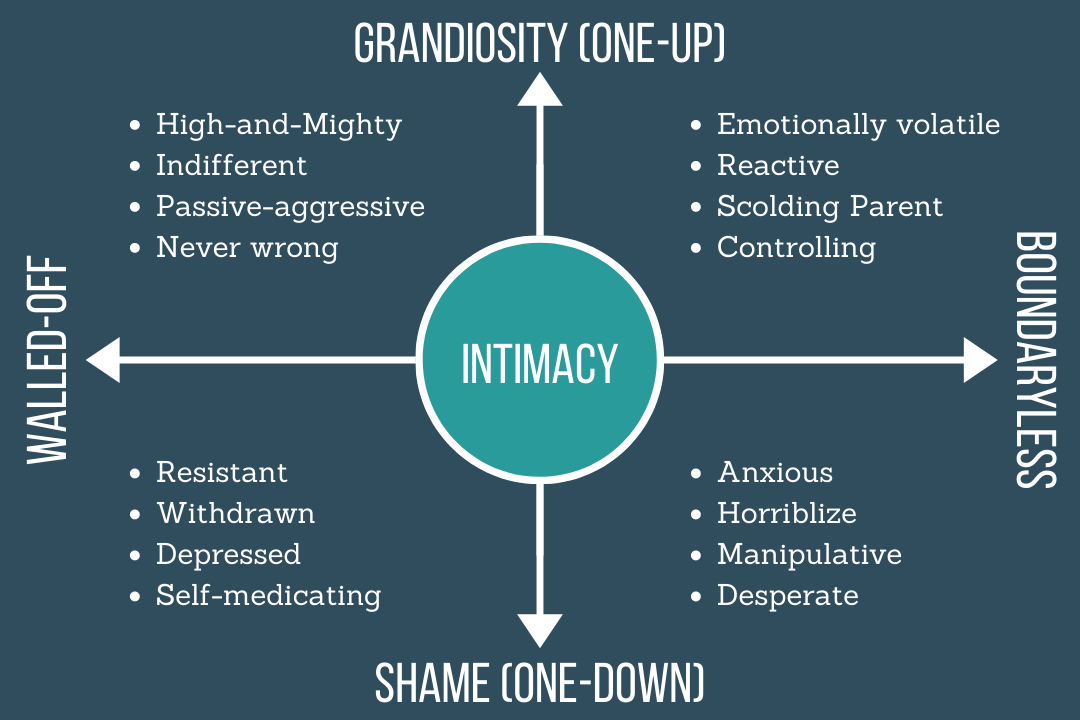
Understanding Terry Real’s Relationship Grid
Renowned couples therapist Terry Real created The Relationship Grid to help partners understand the dynamics that block intimacy. The grid maps relationships across two intersecting dimensions:
-
Self-esteem (healthy vs. toxic)
-
Boundaries (too porous vs. too rigid)
From these two axes emerge four quadrants, each representing a distinct way people show up in relationships — especially under stress.
1. One-Up / Grandiose Quadrant
-
Behavior: Dominance, control, defensiveness, criticism, or withdrawal cloaked as superiority.
-
Internal Experience: Fear of vulnerability or shame masked by self-righteousness.
-
Treatment Focus: Building empathy, accountability, and softening into emotional truth.
2. One-Down / Shame-Based Quadrant
-
Behavior: Pleasing, apologizing, over-adapting, or losing one’s sense of self to keep peace.
-
Internal Experience: Deep fear of rejection and not feeling “good enough.”
-
Treatment Focus: Restoring self-worth, boundaries, and confident voice within the relationship.
3. Boundaryless / Enmeshed Quadrant
-
Behavior: Over-involvement in a partner’s emotions, rescuing, or losing individuality.
-
Internal Experience: Anxiety when distance or difference appears; identity tied to harmony.
-
Treatment Focus: Differentiation work, learning to stay connected while separate.
4. Boundary-Rigid / Withdrawn Quadrant
-
Behavior: Emotional shutdown, avoidance, or isolation under stress.
-
Internal Experience: Fear of engulfment or being overwhelmed.
-
Treatment Focus: Rebuilding trust in connection, learning to stay present through discomfort.
The Goal: Returning to the Center
Healthy, secure connection lives in the middle of the grid — where self-esteem is stable, boundaries are flexible, and both partners can stay present even in conflict.
Here, couples don’t compete for power or disappear to keep peace. They stay in relationship — rooted in empathy, curiosity, and shared regulation.
But for many, early attachment wounds and unprocessed trauma make this balance feel unreachable. That’s where Brainspotting and EMDR come in.
How Trauma Shapes Relationship Patterns
Our attachment styles and relational reflexes are written through our earliest experiences of safety and care. When those experiences involve trauma — neglect, chaos, emotional inconsistency, or even subtle invalidation — the nervous system learns survival patterns instead of relational ones.
-
The One-Up partner may have learned that control equals safety.
-
The One-Down partner may have learned that compliance prevents rejection.
-
The Withdrawn partner may have learned that emotional distance keeps peace.
-
The Boundaryless partner may have learned that their worth depends on being needed.
These strategies protect us — but they also keep us from true connection.
Using Brainspotting and EMDR to Heal the Grid
Both Brainspotting and Eye Movement Desensitization and Reprocessing (EMDR) are therapies that help release trauma stored in the body and nervous system. When applied to couples work, they help partners process the emotional residue that fuels their grid positions.
Brainspotting for Couples
-
Works through eye positions connected to emotional and somatic responses.
-
Helps identify the body-based anchors of shame, fear, and defensiveness.
-
Supports co-regulation as each partner learns to stay grounded in conflict.
-
Builds emotional attunement — the felt sense of “you see me, and I see you.”
EMDR for Relationships
-
Reprocesses painful memories that trigger current reactions.
-
Reduces reactivity by rewiring the brain’s threat pathways.
-
Builds new associations of safety and empathy between partners.
By blending Terry Real’s relational framework with neurobiological processing tools, couples can do more than understand their patterns — they can transform them.
From Dysregulation to Co-Regulation
When each partner’s nervous system is dysregulated, the relationship grid becomes polarized — one person goes “up,” the other goes “down.” Through Brainspotting and EMDR, both partners learn to recognize the body’s cues of defense and move toward co-regulation — where safety and calm are shared, not earned.
In this space, the couple can return to the center of the grid:
-
Grounded in self-esteem
-
Boundaried yet open
-
Confident yet compassionate
-
Separate, but deeply connected
Couples Therapy Intensives in Virginia
For couples who feel stuck or exhausted by repeating the same patterns, intensive sessions offer a deeper, more immersive healing experience.
In Couples Intensives in Virginia, partners spend 3–6 hours (or more) in guided Brainspotting, EMDR, and relational repair using the Relationship Grid as a roadmap. These extended sessions allow the nervous system to fully process long-held emotions and move toward lasting connection.
Final Thoughts
Every relationship has a grid — the question is, can you find your way back to the middle?
By combining Terry Real’s Relationship Grid, Brainspotting, and EMDR, couples therapy in Virginia helps partners move beyond insight into embodied healing. It’s not just about learning to communicate; it’s about learning to feel safe enough to love fully again.
For more on couples counseling click here
https://coastalclaritypsychotherapy.com/couples-counseling/
Share this story

Carter Bain, LCSW is a Virginia Beach based psychotherapist offering online EMDR and intensives for individuals and couples.